case study · COFORGE Client engagement · pharma supply chain
Reading Guide
What this is: a client-facing POC showing how procurement teams can act 30 days earlier on drug shortages.
What you’ll learn: the bet (outcomes), the primary user, and the one-screen decision loop (Drug Detail).
For quick summary : read 02 (Outcomes) and 04 (Deep dive).
30-days
Forecast horizon, surfaced on every drug page
8
End-to end screen shipped to clickable prototype
Duration
10 Days
💰The cost of doing nothing
— STAKEHOLDER MAPPING SYNTHESIS, RXRADAR DISCOVERY
🧱What we build
01
ML model trained on historical supply, sales velocity, regulatory events, and recall feeds — surfaced as a forecast chart, not buried in a report. v1 model target: >80% precision on a 30-day window for Tier-1 sterile injectables.
30-day shortage forecast on every drug page
02
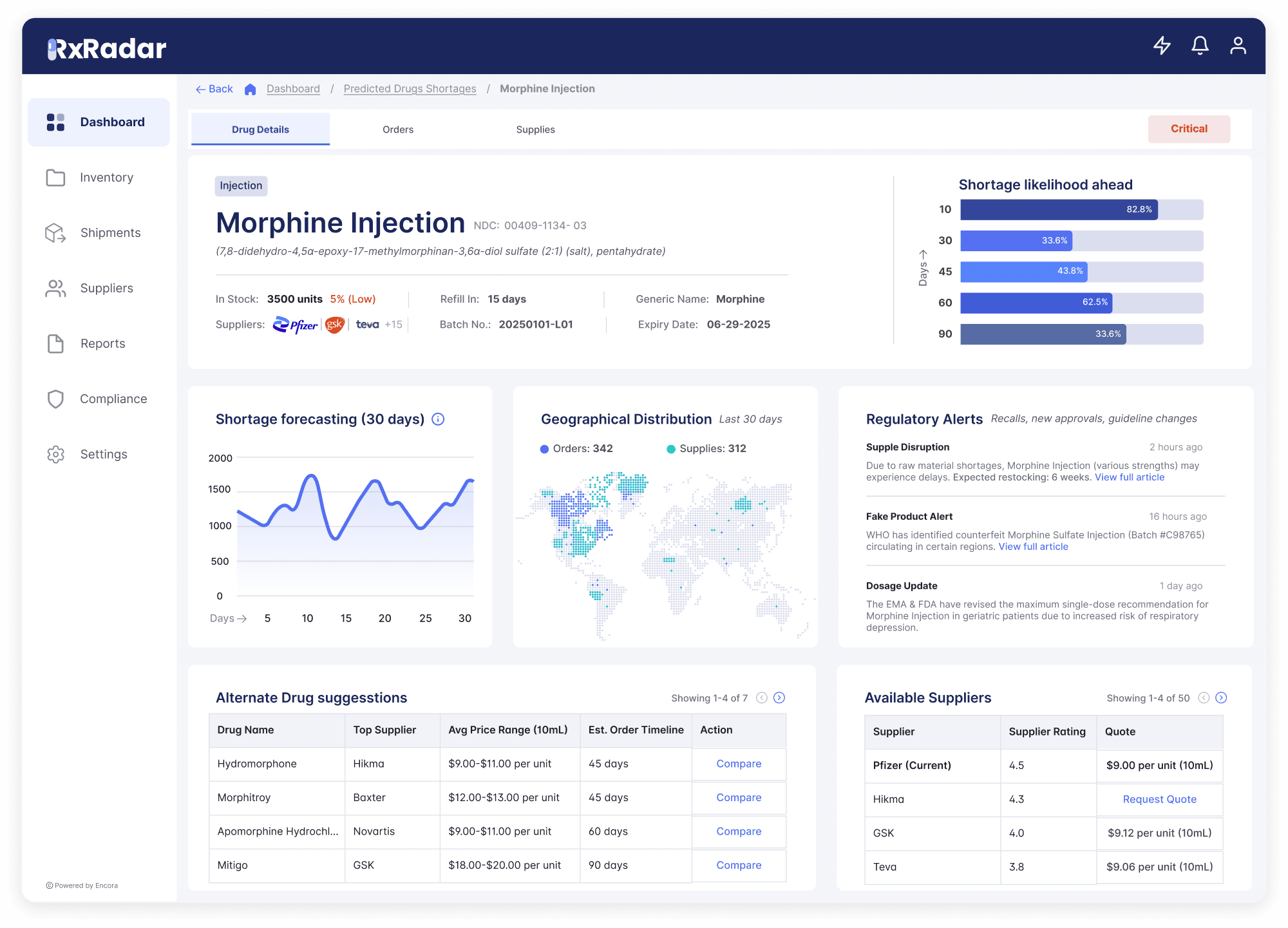
Forecast → regulatory alerts → ranked alternates → live supplier quotes, all collapsed into the Drug Detail page.
One screen replaces five tabs
03
Substitutes ranked on potency, dosage equivalence, cost, and clinical compatibility — not just chemical class. Match score model targeted >0.75 weighted F1 against pharmacist-validated pairings.
9 / 10 match score for every alternate
04
Procurement Directors compare suppliers and request a quote without leaving the drug they are investigating.
FDA / EMA / WHO alerts as a primary surface
05
Recall, counterfeit and dosage-update alerts live in the same frame as the procurement decision — not a footnote.
In-context Quote action
TRANSLATED TO THE USER’S DAY
"A decision that used to start with “Why are we out of this?” — now starts with “We have 30 days. Here are three substitutes ranked, five suppliers ranked, the recall update logged. Let’s act.”
👥 The user we built around

Deep Dive

01
A line chart projecting shortage probability over the next 30 days, anchored to a Last 30 days reference. The forecast is the hook.
Why now? — 30-day forecast
02
Orders 342 vs Supplies 312 — the user sees where the gap is concentrated, not just that one exists.
Where? — geographic heatmap
03
Live, time-stamped, sourced: Supply Disruption · Counterfeit Alert · Dosage Update. The difference between a defensible decision and a regulatory incident.
What’s changing? — regulatory alerts
04
Hydromorphone (Hikma) — $9–11 · 45 days · 9/10 match. Ranked on potency, dosage, cost, clinical compatibility — not just chemical class.
Substitute? — alternate drugs
05
Pfizer (Current, 4.5) · Hikma 4.3 · Baxter · Novartis · GSK. One-click Quote action, in context.
From whom? — supplier quote
📈 five decisions
01
Predict, don’t just report.
02
Procurement Director as primary, everyone else through roles.
03
Forecast → Alternate → Quote, on one surface.
04
Trust as a UI primitive, not a tooltip.
05
Start with the screen that does the most work.
🪞 WHAT’S NEXT & REFLECTION
TRANSLATED TO THE USER’S DAY
“v1 build for client leadership review. Next: a two-week shadow study with a Tier-1 hospital procurement team — instrumenting forecast click-through, alternate-acceptance rate, and time-from-alert-to-quote-request against a baseline week of phone-tree procurement.”
What this project shaped in me
“How to anchor a wide stakeholder map in a single, defensible primary user.”
“How to make trust a first-class component, not a copy decision.”
“How to fold a multi-step decision into one screen without losing the rigor of each step.”
“How to design inside a system where a missing UI affordance has a real clinical consequence.”